The carcass arrived in a four-by-four cardboard box, double-wrapped in trash bags with three air fresheners tucked inside. It was mostly bones, which were attached at the joints with strips of dried skin and muscle, and then, at the rump, overlaid with a thick band of hide still dotted with the pale fur that gave Odocoileus virginianus the common name of white-tailed deer. But it wasn’t just this: There were spiders and ants living inside the skull, maggots bored into the skin. Husks of dead beetles collected in the corner of the box like shriveled up packing peanuts, smelling of mildew, their mummified appendages still clinging dirt from their native earth.
Everything was sticky.
I closed the box and dragged it out of my mailroom, up four flights of stairs, and into my suite. My roommates’ doors were shut, so I quickly pushed it down the hall to our living room. Under my phone light the package revealed an even greater biodiversity of roaches and earwigs, as well as a green wetness around the braincase. More and more things were waking up, producing a biological warmth that radiated through the cardboard. But once I felt vibrations at the base of the box, humming with the processes of decay, I stopped investigating altogether.
Washing my hands, I debated if this was my fault since I’d long advertised my bone farm as a sort of charitable enterprise on which the future of my career depended. However, despite others’ imaginations of it as a well-oiled, professionalized facility— or, more laughably, as an officially sanctioned project on behalf of the university— it was just a ditch behind the train tracks where I put roadkill in empty water drums and waited for it to rot. And while I’d received small things before—a squirrel skull and a couple turtle shells— I couldn’t guess the reason that would compel my ex-girlfriend to ship me a dead animal all the way from Texas, other than the fact that her new engagement had made her generous in ways she never was with me.
Thanks so much, I texted her, parlaying my annoyance into a joke. Especially for the maggots.
Np, she responded. His name is Cornelius.
Where from? I said.
The woods :) let me know how he turns out!
I texted out a long reply but deleted it, figuring she’d said all she was going to. Then I pushed the box back into the corner of the room, weighing down the flaps with textbooks. My reasons for rotting animals were academic, of course, and perfectly harmless despite what others would later insinuate. I was half-way done pursuing a PhD in zoology and was the department’s only graduate student capable of teaching mammalian osteology. However, the department’s osteological collection was lacking, and part of my five-year funding package was contingent on me improving it, even though the details of how to do this were never made clear.
At this point I’d doubled the collection by thirty specimens and owed them about fifteen more. But processing carcasses was a seasonal effort in the Midwest, and the timing of Cornelius’ arrival had put me in a bit of a bind since it was January— three months past my birthday, mind you— in the middle of the COVID lockdown, and the ground was covered in at least a half-inch of ice. Even worse, I lived on the fourth floor of an eight-story graduate dorm in a suit with no windows, six bedrooms, and thermostats that could not be changed. My other five roommates were more ghosts than people, only known to me from the moments we overlapped in the kitchen or at the dryer or awkwardly caught each other at the door.
Most of them were nice enough, but none of them were normal. One was an engineering PhD student who couldn’t keep eye contact for over three seconds and walked around the living room with a teddy bear she kept on a leash. Another was from Norway, pursuing a masters either in ecology or economics, though the mushrooms he was growing in his closet suggested the former. Then there was the MBA candidate, whose main issue was just being a douchebag, and the one guy who only wore black and covered the fridge with Hello Kitty magnets.
I looked at the deer and thought about dragging it the mile and a half to the bone farm. Then I closed the box flaps and put a towel over it and figured that if I sealed it inside a bigger plastic box with duct tape and plastic wrap nobody would be able to tell it apart from all the other boxes they’d ignored since moving in.
Mostly though, I just had to make sure that Luke didn’t find it.
He was the only one who used our communal space, and since he’d moved in last month— to pursue a master’s degree on cannabinoids— he’d developed a habit of leaving the television turned to Spike TV, day and night. At first, I simply turned it off when he wasn’t around. But as the weeks wore on the nights of waking up at 2 am to someone getting their testicles impacted on Jackass lost its charm, as did the idea that I was enabling the bad habits of an at least twenty-five-year-old man.
However, when I brought this up to him, he looked at me dumfounded, almost angry.
“Why wouldn’t I?” he said. “It’s free energy.”
I waited for a joke to reveal itself.
“What?”
“It’s free energy,” he said. “We don’t pay for it. The university does. You get that? You sound like my fucking ex.”
Luke suddenly got very angry and very loud. And as he doubled down on the value he was deriving from his laziness, it occurred to me that he was someone who could only be reasoned with materially.
“It’ll ruin the screen if you do it for too long,” I said, interrupting him.
He scrunched his face.
“Really?”
“Yes.”
I switched the TV on to show him, which, in hindsight, was a mistake since it was turned to CNN.
“You see?” I said, pointing to a spot of dimness in the upper right-hand corner. “It’ll give out over time.”
I softened my voice like I did with my students when they were hopelessly confused, however Luke wasn’t listening to me anymore; transfixed by the line graph of February’s projected COVID deaths.
“Can you believe this shit?” he said. “We’re wasting our lives trapped in here because people who aren’t strong enough to live might die of a cough? Isn’t that a sign that they just should?”
“Should?”
Luke licked his lips, staring at the news anchor like he was going to hit him.
“Die.”
This wasn’t the first time I’d had Malthusian rhetoric spewed in my face, but hearing it from Luke—who, at 5’5”, had risen onto his tiptoes so his lifeless, unblinking eyes could meet mine— was particularly disturbing.
He reminded me of a kind of creature that responded only to basic stimuli, like an insect or a fish; someone who was always waiting for an empty stomach or full bladder or a social media post to tell him what to do; a man whose actions could never be anticipated.
“You ever notice how Teddy Bear Girl wears masks all over the place?” he said. “It’s weird, isn’t it?”
Smiling, his scalp glimmered beneath his buzzcut.
“I mean, if people want to suffocate themselves,” he said. “They can. They should. But they shouldn’t make me do it too. That’s not their business.”
Moving back into the kitchen, he took a box of Lucky Charms from the cupboard. He started to hum, tapping on the counter. After a few moments I recognized it as Ride of the Valkyries.
“You want some?” he said.
Luke held the box at an angle towards me and jangled it around like it was a box of dog treats.
His sudden shift in demeanor embroidered the scene with a concerning intimacy.
“Ha ha, thanks man,” I said. “But I have to get somewhere.”
Luke sighed.
“Shit. Next time brother.”
He did a little salute as I dipped into the hall and searched for the first jacket I could find. Truthfully, I had nowhere to be. But I left the apartment in a hurry and walked into town, freezing the entire time, and hoped that by the time I got back he’d be gone.
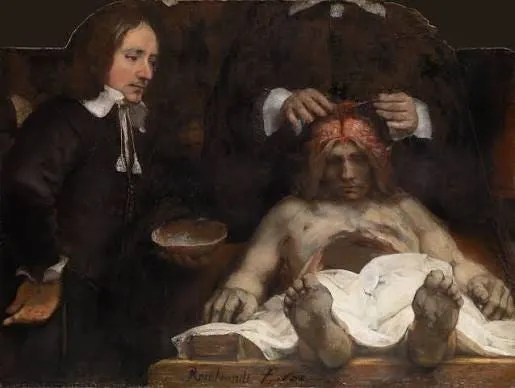
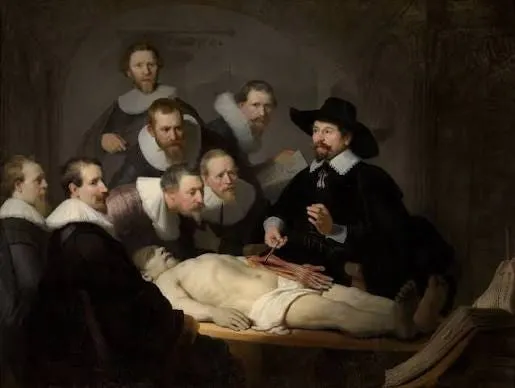
Rembrandt van Rijn, The Anatomy Lesson of Dr. Deijman, 1656
That night, I set Cornelius in the plastic tub and filled it with water to loosen up the dried tissue so that, in a month or two, it’d fall off the bone. Then, I duct taped the lid shut and wrapped saran wrap over it before finally layering over more duct tape. I put the box in three layers of plastic bags, taped an index card on the outside of this that said “DO NOT TOUCH”, and threw a cloth sheet on top of it. Finally, I scooted it to the corner of the living room and hid it behind a pile of cardboard boxes.
As predicted, nobody noticed. And after a few weeks, I’d even started to forget about Cornelius, overwhelmed by teaching and the deadlines for my proposal defense, though Luke also gave me plenty to focus on. He was drinking too much, smoking inside, getting into shouting matches on his phone. He’d curated a group of misanthropes who randomly showed up in my living room at all hours of the day, usually dead-eyed and always high. Once he hosted an Xbox night where two of these guests got into a fight and one knocked the other’s incisor out with a bong. But when the cops arrived, they found no bong and a dorm full of men who claimed their friend had walked into a door.
Then, a week later, Luke started growing weed on Cornelius’ box.
Granted, he had started growing weed everywhere: On the kitchen counter, on the living room floor, on the bookshelves, on the coffee table, under the TV, above the TV. And what was worse was that he’d clearly made inroads with the other roommates; at least enough so that they’d look the other way. One evening I saw a picture of Luke and the MBA douchebag skydiving out of a plane on the fridge. Above it, partially obscured by a hello kitty magnet, was a caricature of Luke, the Norwegian guy, and Mr. Hello Kitty himself from one of the winter markets upstate. Its implications were disorienting, insulting even — to realize that life had continued in my absence — and as I studied it Teddy Bear Girl came into the kitchen, her bear trailing behind her on a leash. She pointed at the weed.
“Are you a part of that?”
“No,” I said, taken aback. “Of course not.”
She nodded
“It’s illegal.”
Her words wavered as if weighed down by privileged insight; as if Teddy Bear Girl— whose name I remembered was Rachel— was the sole adult in the room.
“I think it’s just a misdemeanor now,” I said.
“That doesn’t matter— it’s not right… It just isn’t.”
“It’ll be gone soon enough. Probably.”
“He’s using us.”
“Well,” I said, peering into the tear developing around the bear’s neck. “Let’s just give it one more week. I don’t want to talk to him either, you know.”
Rachel squeezed the bear tight against her chest. It embarrassed me to watch this: a grown woman seeking solace in a toy, not knowing any better than to hide this. But in looking away from her, I stared again at the skydiving picture and realized that we were the odd ones out; the people Luke had deemed too weird to associate with.
“So you’re just going to let him have this?” she said. “Let him bring all those weirdos in here whenever he wants?”
I bit my tongue, balancing her question with my sudden dejection; watching as she thumbed the tear, nervously working the stuffing in and out.
“No.”
She looked at me matter-of-factly.
“Okay,” I said.
“Okay?”
“I’ll talk to him.”
“When?” she said.
“Soon.”
“What does that mean?”
“I don’t know,” I said. “Soon.”
Rachel made a face, nervously picking at the skin on her upper arm, exposing small sores. Then she grabbed the bear tight by the neck with her free hand, tensing so that a few small drops of blood raised from her wounds. Slowly the blood collected in small rivulets down the length of her arm, beading at her wrist. When she realized this she turned away and wiped it off with a paper towel, washing off the bear too; apologizing to it.
Retreating to my room, I texted Luke.
Hey man
Hi
How’s it going?
Good.
Hey man. Can we talk about the weed?
What weed
The weed in the living room.
There was a momentary ellipsis, and then nothing. He responded three days later.
Not home.
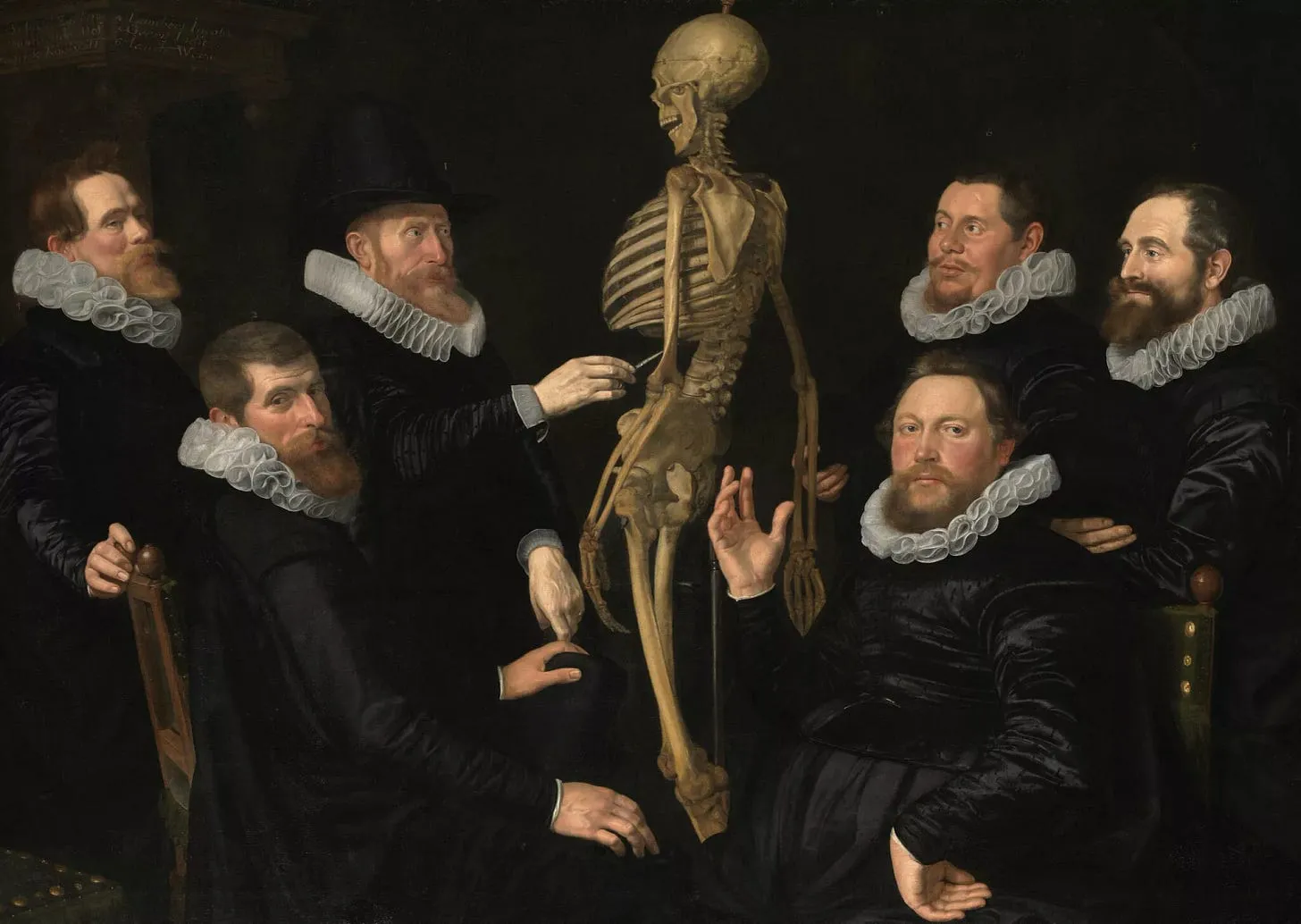
Nicolaes Eliasz. Pickenoy, The Osteology Lesson of Dr. Sebastiaen Egbertsz., 1619
The next time I saw Luke the plants were knee-high and there had just been a police killing in town. A homeless guy had been threatening passersby who refused his very specific and Hermetic understanding of God, which, apparently, hadn’t amounted to much beyond taking a shit outside of the Potbelly on Main Street. However, this didn’t dissuade the cop from fatally shooting him twice in the back, surrounded by pedestrians armed with iPhones and a pent-up desire for something to do.
A protest had formed a few blocks away from our dorm and could be clearly heard as Luke and two friends—business associates, perhaps—weighed various powders in the living room. Luke distributed a pile between three bags and handed them to one of them who palmed him something back. He was making small talk about the police and what bullshit it was that cops weren’t allowed to do their jobs anymore. I wasn’t sure if the other two were following because of how high they obviously were, but it didn’t stop them from nodding and cutting up a few lines.
“Hey,” I said, once it was clear they weren’t going to acknowledge me.
Luke perked up, gumming something. The furniture had been rearranged, and all of the boxes, including Cornelius’, had been pushed to the opposite side of the room.
“What’s up Paul?”
“It’s Philip,” I said.
Luke yawned. The afternoon light hit him in such a way to deepen the wrinkles prematurely etched in his face, which was pale and in bloom with acne.
“What’re you guys doing?” I said.
“Nothing.” Luke rubbed a hand on his neck while the other two smirked at each other. “Were you out there?”
“No.”
“Good,” he said, exhaling. “Fucking retards.”
As if on cue, the voices outside swelled amid an eruption of drumming and chanting. Luke gritted his teeth, and the fatter of his friends suggested another line.
“Luke,” I said, attempting to draw his attention from this. “About the weed-”
“They should shut the fuck up. Fucking understand what it means to be an American.”
His hands were suddenly fists; white and trembling at his sides. I took a step back and then looked at his friends, who were focused on their phones.
“They’re upset,” I said.
“About a dead bum?”
“He was a person.”
“He was a bum.”
“Alright, dude.”
“You think free riding is okay? You don’t think we should have laws?”
“I didn’t say that.”
“So you agree with me.”
“No.”
Shaking his head, Luke went over to the fatter friend and did a line and then paced around the room. His eyes glossed over everything they looked at, including me.
“I don’t think completing six weeks of glorified PE qualifies someone to be judge, jury, and executioner,” I said.
Luke growled.
“My dad is law enforcement.”
“Okay,” I said. “What am I supposed to do with that?”
Luke turned his head half away from me, getting red at his cheeks. He stared at his phone, grimacing, and it was as if I could see the gears turning behind his eyes; the reactive brunt of his imagination.
“Listen,” I said. “You can’t grow weed in here, man. And since we’re on the topic of law and order, it’s illegal.”
Luke smirked.
“Illegal?”
“Yeah.”
“Like you give a shit.”
“Excuse me?”
“Illegal. Illegal. Illegal,” he said, snarling. “If this is illegal, then what do you call this?”
Luke held up his phone and opened a photo album called “Paul”. He pulled up the first entry, which was a forty second video of him unwrapping Cornelius’ box and silently stirring the goop around with a gloved hand; exposing dirty bones and chunks of things— the pupae of incubating flies— before pointing to my last name on the shipping label. Then, more disturbingly, he showed me the rest of my album, which contained pictures of specimens I kept on the bookshelf: the cat skeleton and the pitbull skull and the pair of rats in formaldehyde, none of which I’d ever aesthetically considered from another’s vantage.
“Plus,” he said, flipping to the final image of a large blue candle on my nightstand. “You aren’t allowed candles in the dorm. It’s explicitly against the rules. That alone could be reported.”
“You went into my room?” I said. “You’re a freak.”
“Says the fucking serial killer.”
He punched the table, denting the faux-wood paneling. Then he kicked one of the chairs and upended it and looked at it and kicked it again.
“Do not,” he said, not quite landing his thesis. “Do not do not do not.”
I dodged his advance, knocking a metal water bottle off the table— swearing at him— and then heard a baby shriek. At first, I thought it was coming from outside, like maybe someone was dangling it from a window above us. However, as the noise continued all four of us looked down to where it clarified in the hallway, and Luke ran into his room, slamming the door.
“What is that?” I said.
“That’s his kid, man,” the balder of the two men said, running a tongue over his teeth. “You got his little girl worked up now.”
“He has a kid?”
“Uh huh.”
“Since when?”
The two guys looked at each other, shrugging. I heard Luke urgently hushing the baby to quiet down.
“Hey man,” the fatter one said now, his eyes slits. “You sure you don’t want some? Best price in town. On God.”
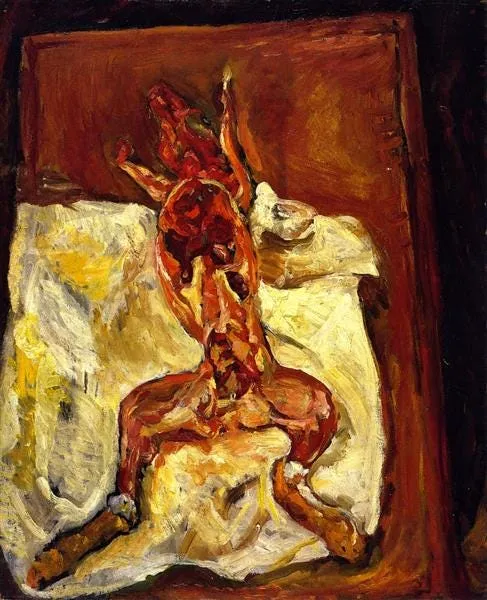
Chaim Soutine, Flayed Rabbit (Le Lapin écorché), c. 1921
I saw little of anyone else over the next few weeks, and every time I stepped foot in my dorm I felt a dull, nervous pit in the core of my being. I put locks on my bedroom door and rewrapped Cornelius’ box, which remained in the living room. The baby, I’d learned from texting the Norwegian, was from Luke’s last relationship and was going to be staying with him for a while. I asked him about the mother and the Norwegian said IDK. Then I asked him if he talked to Luke regularly and he said he hadn’t because Luke called him a fag for wearing toe shoes. When I told the Norwegian I was sorry to hear that, he didn’t respond.
I never actually laid eyes on the baby. I heard it scream every so often, but Luke seldom brought it out of his bedroom as he seemed to be making himself scarce. It was a tense situation, not knowing whether or not to be relieved; to stare at the stove and contemplate the risk of running into him while cooking pasta. But the days began to pass without me detecting so much as a trace of him, minus the marijuana plants, which were, slowly, being harvested. Soon the looming promise of Daylight Savings had made me hopeful and idealistic enough to decide my issues with Luke were over, and I started to forget that I’d ever had issues with anyone at all.
It was in this mood that Rachel posted the first text on our GroupMe that it had received in months:
Hey Philip, the taped box with the black liquid is creating a lot of little flies and I was hoping we could somehow move that out of the apartment.
And then, a minute later, an attempt at empathy:
I know you taped it pretty well but they’re somehow getting out.
I started sweating.
Oh shit. Will get on it.
It was noon and I was already on my way home from campus. Cutting through the law quad, I picked up my pace on South University and made it back in under ten minutes. Working through a number of excuses, I settled on one about a composting experiment that I thought would calm her down. However, when I got to my floor there were police officers up and down the hall and, skipping past them, I reached my suite and saw four more inside. I stepped inside as a fifth popped out of my bedroom shaking his head, and then they all stopped and looked at me.
“Sir,” the closest one, old and fat, said. “Sir, who are you?”
“Excuse me?” I said. “What are you doing?”
“Who are you?”
“I live here.”
“Sir. I need an ID.”
The cop held out his hand as the other waited for me to make a scene. Instead I took out my wallet and handed him my driver’s license, which appeased him, for the moment, and which earned me a place to stand in the back of the living room next to Rachel, who was gripping her stuffed bear, crying.
“They just… showed up… They wanted to know if Luke was here,” she said. “I didn’t know they were going to do this.”
I told her it was okay, but she looked more concerned about the bear than my assurances, holding it obliquely behind her, as if she didn’t want the cops to see it.
“Really,” I said. “It’s gonna be fine.”
I watched the cops converge on Luke’s room, and then heard a bed upturn and drawers open and close. One of them carried out a large cardboard box full of his stuff and then came into the living room and started looking through the clutter there.
I knew what was going to happen before it did, and by the time Cornelius’ lid had been opened—his smell spreading across the room like a chemical spill—I had my lie ready.
“What is that?” the cop said.
“It’s compost.”
He thought about this, frowning.
“You need to dump it. Now. Outside.”
The cop scowled at me and Rachel like we had been in on this together. I felt a bit guilty.
“Can you tell us what is going on?” I said.
“What do you think is going on?”
“I don’t know,” I said. “That’s why I asked.”
At this point he was, I was pretty sure, fighting the urge to roll his eyes.
“Your friend abducted a child.”
“My friend? You mean Luke?
“Yes.”
“And by child… You mean his baby?”
“Looks like it.”
Rachel and I glanced at each other.
“So…”
“So, obviously we are trying to find this child.”
The cop gestured for us to get along with the box, flaring his nostrils. I grabbed one side of it, looking at Rachel for help, and once she realized this a look of disgust passed over her face.
“Too-day,” the cop said, clearing his throat.
Rachel took a breath and then begrudgingly picked up the other side and joined me in ambling down the hall and into the elevator. As we descended, I stared at myself in the mirrored keypad, watching the numbers countdown, failing to make eye contact.
“I appreciate your help,” I said.
Rachel nodded. She was still crying.
We dumped the tub out in the front yard of the dorm. The water smelled like rot and soured notes of Cool Breeze air fresheners, and I was momentarily taken aback by the fact that I’d allowed this to ferment inside our apartment.
“Is that it?” Rachel said, not looking at the sludge.
“Yeah.”
“Okay.”
“Hey,” I said, looking her in the eyes. “Thanks.”
“Okay.”
She left in a hurry, sniffling, which I thought was a bit pathetic even as guilt pierced deeper into my chest. But this was more than I’d ever done for her, I realized; it was the first time I’d seen her without the bear.
Getting on my knees, I dug through the box as passersby stared at me, piecing together Cornelius, who was finally slick and clean and fully bone. There was a hole on one side of his skull that continued in a larger way on the other, and when I hosed him off I found the bullet that did it.
“I’m sorry,” I said, thumbing the metal, breathing in his stink.
Tossing the bullet into one of the sidewalk trashcans, I glanced up as the door opened and the police filed out, exasperated. The fat one glared at me before getting in his car, the skydiving picture in his left hand, the caricature in his right. Then he pulled out and sped down the road, the others trailing after him, and I laid the bones out in the grass and watched them until there was nothing left to see.
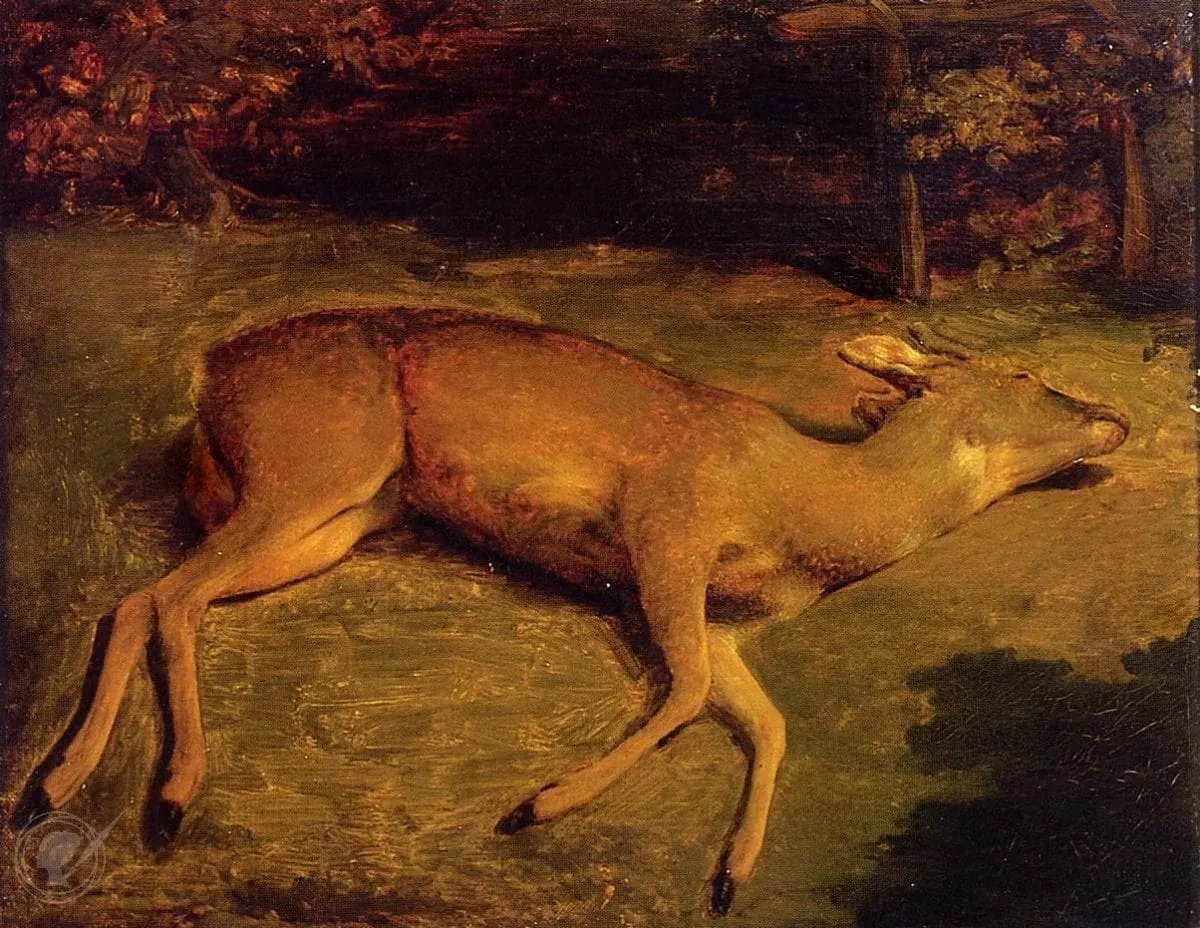
Gustave Courbet